
Gunahon Ka Devta Was Never a Love Story. It Was a Story About a Woman Nobody Listened To.
Blog post description.
Kriti Singh
7/16/20267 min read
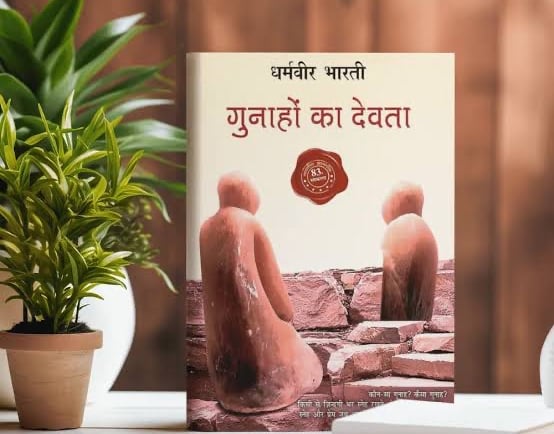
For decades, Gunahon Ka Devta has been celebrated as one of the greatest love stories ever written. Readers cry over Chandar and Sudha, praise Chandar’s sacrifice, and mourn a love that could never find its rightful place in the world. Chandar is remembered as a tragic hero a man torn between duty and desire, morality and love
I disagree.
Every time I revisit this novel, I find myself sympathizing with Chandar a little less and grieving for Sudha a little more.
Because somewhere beneath the discussions about sacrifice, purity, and ideal love lies an uncomfortable truth: Sudha’s tragedy begins the moment everyone around her decides they know what is best for her.
Not once does anyone seriously ask what she wants.
And the most heartbreaking part is that the person who understood her better than anyone else becomes the one who silences her the most.
That person is Chandar.
People often defend Chandar by saying he sacrificed his happiness for Sudha’s future. That he wanted her to have a stable home, social respectability, and a secure marriage. He believed his love was too sacred to be reduced to marriage. He believed that denying himself was the nobler choice.
But sacrifice only has meaning when the person making it is sacrificing their own happiness. Chandar wasn’t sacrificing only himself.
He was sacrificing Sudha too.
Without her consent
Throughout the novel, Sudha’s feelings are rarely treated as decisions. They are treated as emotions that need to be managed.
When the question of her marriage first arises, Sudha does not greet it with excitement. She resists it. She expresses her reluctance. She does not want her life to change overnight. More importantly, she cannot imagine a future separated from Chandar. The emotional centre of her life has always been him. This is not something Chandar fails to notice. On the contrary, he understands it better than anyone else.
And yet, despite understanding exactly how deeply Sudha depends on him, he chooses not to question the system that is taking her away.
Instead, he becomes its most effective messenger.
Dr. Shukla trusts Chandar implicitly. He asks Chandar to convince Sudha to agree to the marriage because he knows she listens to him more than anyone else. It is one of the cruelest ironies in the novel. The only person who could have defended Sudha’s wishes becomes the person entrusted with dismantling them.
This moment deserves far more criticism than it usually receives.
Readers often frame Chandar as someone trapped by society, but Chandar still possesses something Sudha does not.
Choice.
He can object. He can refuse. He can speak.
He can tell Dr. Shukla that this marriage will destroy both of them.
Instead, he convinces himself that silence is virtue.
The novel repeatedly presents Chandar as someone governed by ideals. He believes love must remain pure, untouched by physical desire or social institution. Marriage, in his mind, would somehow diminish what he shares with Sudha. He elevates their relationship into something almost spiritual, convincing himself that denying their love is proof of its greatness.
It sounds noble.
Until you remember that Sudha never asked for this philosophy.
This is Chandar’s ideology.
Sudha never argues that love is too sacred for marriage. She never says she wants to spend her life proving some higher moral principle. Those ideas belong entirely to Chandar. Yet it is Sudha who is forced to live with the consequences.
That is why I struggle to call his actions selfless.
They are deeply paternalistic He decides what kind of life will make Sudha happy without ever allowing Sudha to decide it herself.
Perhaps the greatest misunderstanding surrounding Gunahon Ka Devta is the assumption that Kailash’s goodness somehow justifies Chandar’s decision.
It doesn’t.
Kailash is not portrayed as a monster. In many ways, he is exactly the sort of husband society would approve of. Responsible. Educated. Respectable. Bharati deliberately avoids making him the villain because the novel is not arguing that Sudha married the wrong man.
It is arguing something far more devastating.
Sometimes even the right husband cannot heal the wound created by denying a woman the right to choose.
This distinction matters because readers often reduce Sudha’s tragedy to romantic heartbreak, as though her suffering began only after she entered another household.
I think it began much earlier.
It began the moment everyone assumed her acceptance mattered more than her consent.
There is a subtle but important difference between the two.
Sudha eventually agrees.
But agreement achieved through emotional dependence is not freedom.
She trusts Chandar with absolute faith. His words carry more weight than her own instincts. When he tells her that marrying is the right thing to do, she believes him—not because she suddenly desires the marriage, but because she has spent her entire life believing Chandar could never lead her astray. Readers and critics alike have long noted this almost devotional trust that Sudha places in him.
And that is precisely why Chandar’s responsibility is greater than everyone else’s.
He knew.
He knew what she felt.
He knew she loved him.
He knew she did not want this marriage.
He knew that if he asked her to walk away from him, she would.
And he still asked. That is not sacrifice. That is influence.
Perhaps even power.
The tragedy of Gunahon Ka Devta is not that society separated two lovers.
It is that Chandar voluntarily became society’s representative in the one place where Sudha needed him to become its rebel.
He believed he was protecting her future.
Instead, he dismantled the only future she had ever wanted.
And that is where, for me, Chandar stops being merely tragic.
He becomes responsible
If Chandar’s greatest mistake was convincing Sudha to marry, his greatest failure came afterwards.
Because once the marriage was over, reality refused to validate everything he had believed.
If Chandar truly understood Sudha, he should have expected that marriage would not simply erase her feelings. Love is not a switch that turns off because a wedding has taken place. Yet that is exactly what his decision seems to rest upon that once Sudha entered a respectable household, she would gradually adapt, accept her circumstances, and find happiness.
Instead, she slowly falls apart.
This is where Gunahon Ka Devta quietly dismantles Chandar’s entire worldview.
For all his talk of duty and sacrifice, he misunderstands one basic truth about love. He treats it like an emotion that can be disciplined. He believes affection can be redirected through willpower. If he suppresses his own feelings and encourages Sudha to do the same, then eventually they will both become the people society expects them to be.
The novel proves him wrong.
Sudha performs every duty expected of her. She enters her new family. She tries to become a good wife. She attempts to live according to the role assigned to her. But none of this changes where her emotional home truly is.
That is the cruel irony.
She does everything society asks of her.
Society still cannot give her peace.
This is also why I reject the common argument that Chandar “did the right thing because Kailash was a good man.”
Whether Kailash was good is almost irrelevant. The issue was never the quality of the husband. It was the complete absence of Sudha’s choice.
A good marriage cannot compensate for the loss of agency.
In fact, Bharati seems to understand this remarkably well. Had Kailash been abusive or cruel, readers could have blamed Sudha’s suffering on him. Instead, the novel refuses us that easy explanation. Kailash is decent, which forces us to confront a far more uncomfortable possibility.
Sometimes the deepest unhappiness comes not from being treated badly, but from living a life that was never yours to choose.
That is a much harder truth to accept.
It is also why Sudha’s suffering feels so relentless. She is not fighting an obvious villain. She is trapped inside decisions made by people who genuinely believe they acted in her best interests.
That makes her tragedy almost impossible to escape.
Chandar, meanwhile, cannot escape either.
Readers often describe the second half of the novel as his punishment. Wracked with guilt, emotionally adrift, and increasingly unable to reconcile his ideals with reality, he begins to unravel. His relationships with other women become complicated, contradictory, and often self-destructive. The certainty that once guided him disappears.
Many readers interpret this as redemption.
I don’t.
Guilt is not redemption.
Real redemption requires acknowledging the harm you’ve caused.
Chandar spends much of the novel suffering because he has lost Sudha.
That is different from suffering because of what he did to Sudha.
Those are not the same thing.
His pain is real. It deserves empathy. But pain alone does not absolve responsibility.
One of the most fascinating aspects of Gunahon Ka Devta is how often Chandar is praised for his ideals while Sudha is praised for her devotion.
He makes decisions.
She bears consequences.
He chooses.
She adjusts.
Even their suffering is unequal.
Chandar’s suffering comes from a decision he actively made.
Sudha’s suffering comes from a decision made for her.
That distinction is impossible for me to ignore.
And then comes the ending.
Sudha’s death is usually remembered as the final blow in an unforgettable love story. Readers mourn two soulmates separated by circumstance, and Chandar’s grief becomes the emotional climax.
But when I reached the end, I wasn’t thinking about Chandar.
I was thinking about Sudha.
About the girl who had tried, in her own way, to tell people what she wanted.
About the woman whose life became an experiment in someone else’s ideals.
About the person who trusted Chandar more than she trusted herself.
People often ask whether Sudha died because fate was cruel.
I don’t think fate deserves all the blame.
There was nothing inevitable about this tragedy.
At multiple points, it could have been prevented.
Dr. Shukla could have recognised that his daughter’s wishes mattered as much as social expectations.
Chandar could have admitted that loving someone also means respecting their choices instead of making them on their behalf.
Either one of them could have interrupted the chain of events.
Neither did.
That is why I find it difficult to absolve Chandar.
Not because he intended to hurt Sudha.
He clearly didn’t.
His love for her is never in doubt.
His intentions are not malicious.
But literature has never judged characters only by intention.
Consequences and actions matter.
A person can deeply love someone and still become the reason they are destroyed.
Those two things are not mutually exclusive.
Perhaps that is the real tragedy of Gunahon Ka Devta.