
R is for Reality: The Engineered World of Ready Player One
Beyond the game lies a Reality. Discover the "investigative" blueprints of Ready Player One and the Easter Egg hunt that defined a digital generation.
Kriti Singh
4/27/20265 min read
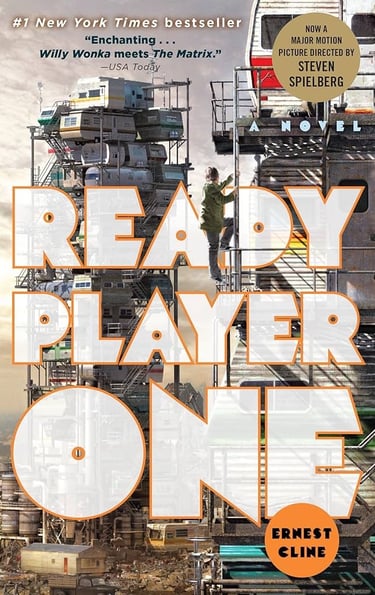
When people talk about Ready Player One, they often reduce it to nostalgia—a dense collage of 1980s references wrapped in a fast-paced adventure. That reading is incomplete. What Ernest Cline actually builds is a tightly structured system: a world governed by rules, incentives, and behavioral manipulation. The novel works not because of its references, but because of how those references are operationalized into a functioning “blueprint” for power, control, and participation in a digital ecosystem. Examined critically, the book becomes less about escapism and more about how systems are designed—and who benefits from those designs.
1. The Retro Roadmap: Halliday’s System as a Controlled Investigation
At the center of the novel is James Halliday’s contest, “Anorak’s Game.” On the surface, it is an Easter egg hunt. In practice, it is a closed system where success depends on total alignment with the creator’s personal history. This is not an open competition; it is a highly curated investigation into one individual’s obsessions.
The key mechanism here is specificity. To progress, participants must study Halliday’s life in granular detail his favorite movies, games, music, and even his emotional responses to past events. Knowledge alone is insufficient; what matters is interpretive accuracy. Players must not only know what Halliday liked but also predict how he encoded those preferences into puzzles. This turns the game into a form of behavioral replication. The ideal player is not the most creative but the most precise imitator.
This structure raises a fundamental issue: access. The contest appears meritocratic, but it privileges those with time, resources, and archival access. Wade Watts succeeds not because the system is fair, but because he is willing and able to dedicate his life to mastering Halliday’s past. In that sense, the game rewards obsession over balance and depth over breadth. It filters participants through a narrow lens of compatibility with the creator’s identity.
The broader implication is that systems designed around personal bias cannot be neutral. Halliday’s “blueprint” defines value based on his own preferences, effectively turning cultural literacy into a gatekeeping tool. What looks like a global competition is, in reality, a closed circuit of validation for a specific type of knowledge. The OASIS becomes less a democratic space and more an extension of Halliday’s worldview.
2. Real-World Recognition: Niche Strategy and Market Risk
From a publishing standpoint, Ready Player One presents an interesting case. Before it became a bestseller, it was a high-risk product. A novel deeply embedded in 1980s pop culture references is, by definition, niche. It assumes familiarity with a specific cultural archive that is not universally shared. Traditional publishing logic would classify this as limiting its market.
However, that assumption overlooks how niche markets operate. Instead of aiming for broad but shallow appeal, Cline’s approach targets a specific audience with high engagement potential. Readers who recognize the references are not passive consumers; they are active participants. They derive satisfaction not just from the story but from decoding it. This creates a feedback loop where recognition reinforces investment.
The success of the book demonstrates that depth can substitute for breadth. A highly engaged niche audience can generate momentum through word-of-mouth, online communities, and cultural discussion. The book effectively turns its perceived weakness its specificity into a strength. It does not dilute its content to reach more people; it intensifies its focus to create stronger connections with fewer people.
The transition from book to film further illustrates this dynamic. When Steven Spielberg adapted the novel, the challenge was to translate a text-driven, reference-heavy experience into a visual medium. The film shifts emphasis from detailed recognition to spectacle, broadening accessibility at the cost of some depth. This adaptation highlights a key trade-off: what works in a niche literary context does not always translate directly to mass-market cinema.


3. The Rigged OASIS: IOI and the Economics of Control
If Halliday’s system defines the rules, Innovative Online Industries (IOI) represents the attempt to exploit those rules at scale. IOI is not interested in playing the game as intended. Its objective is ownership. This distinction is crucial because it shifts the focus from participation to control.
IOI’s strategy is based on resource asymmetry. Unlike individual players, it can deploy teams of researchers, analysts, and operators to brute-force the problem. It treats the contest as a data challenge rather than a personal journey. Every piece of information about Halliday is cataloged, analyzed, and operationalized. This is not curiosity-driven engagement; it is industrialized problem-solving.
The use of indentured labor players working off debts within IOI’s system adds another layer. It turns participation into coercion. Players are no longer autonomous agents; they are assets within a corporate structure. This mirrors real-world concerns about digital economies, where platforms can exert significant control over users’ behavior and opportunities.
The key insight here is that systems designed for open participation can still be dominated by entities with sufficient resources. The OASIS is theoretically accessible to everyone, but in practice, IOI’s scale gives it a significant advantage. This creates a tension between the ideal of a free and open digital space and the reality of concentrated power.
4. Real-World Contrast: Dependency on Engineered Escapism
The final layer of the novel’s structure is the contrast between the OASIS and the physical world. The “Stacks,” where Wade lives, represent systemic failure: economic instability, environmental degradation, and limited upward mobility. The OASIS, by contrast, offers opportunity, mobility, and identity flexibility.
This contrast is not incidental; it is functional. The worse the real world becomes, the more attractive the OASIS appears. This creates a dependency loop. Users invest more time in the virtual environment, which in turn reduces their engagement with physical reality. The system sustains itself by offering an alternative rather than addressing underlying problems.
From a design perspective, the OASIS is optimized for retention. It provides clear goals, immediate feedback, and scalable rewards. These are the same principles used in game design and social media platforms to maintain user engagement. The difference is scale: in Ready Player One, the OASIS is not just a platform; it is a parallel society.
The risk of such a system is not just escapism but substitution. When virtual environments become more functional than real ones, they start to replace them. Education, work, and social interaction all move into the OASIS, reducing the incentive to improve physical conditions. This creates a feedback loop where neglect of the real world reinforces reliance on the virtual one.
Conclusion: A System, Not a Fantasy
Ready Player One works because it is structured as a system rather than a loose narrative. Each component the contest, the market strategy, the corporate antagonist, and the real-world contrast serves a specific function within that system.
Halliday’s game demonstrates how personal bias can shape supposedly open systems. The book’s publication strategy shows how niche targeting can outperform broad appeal when executed effectively. IOI illustrates how resource concentration can distort fairness in competitive environments. The contrast between the OASIS and the real world highlights the risks of over-reliance on engineered escapism.
Taken together, these elements form a coherent blueprint. The novel is not just about a game; it is about how systems are designed, who controls them, and how users interact with them. It invites analysis not because of its references, but because of its structure.
This post is a part of blogchatter A2Zchallenge https://www.theblogchatter.com/