
S is for… The “Slaughterhouse-Five” Syndrome: The Blueprint of a Glitched Life
Beyond the shrapnel lies a Strange. Discover the "investigative" blueprints of Vonnegut’s Slaughterhouse-Five and the Shattered reality of a life " Unstuck in time.
Kriti singh
4/27/20265 min read

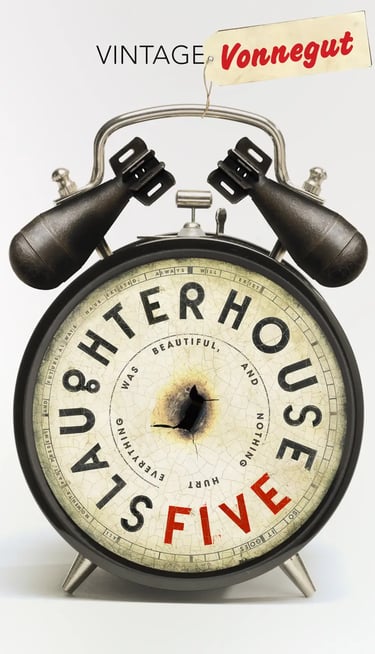
When you spend enough time in the book world, you start noticing patterns. Most stories are built on a clean, predictable structure beginning, middle, end. Cause leads to effect, time moves forward, characters evolve in a straight line. That’s the default blueprint. But every once in a while, a book shows up that completely breaks that system not by accident, but by design
That’s where slaughterhouse fits in
Published in 1969 by Kurt Vonnegut, the novel doesn’t just tell a war story. It rewires how stories about war—and memory—can be told. Instead of a linear narrative, Vonnegut constructs something fragmented, repetitive, and deliberately “glitched.” The result feels less like reading a conventional novel and more like navigating a broken timeline where moments repeat, collapse, and exist all at once.
This article breaks down that design through four key lenses: the long and difficult creation process, the use of repetition as a narrative tool, the controversy around censorship, and the autobiographical layer that turns the novel into something much larger than fiction.
1. The Stuttering Start: A 20-Year Failed Blueprint
Before Slaughterhouse-Five became a defining anti-war novel, it was a problem Vonnegut couldn’t solve.
The core issue wasn’t lack of material—it was the opposite. Vonnegut had lived through one of the most devastating events of World War II: the Bombing of Dresden. As a prisoner of war, he witnessed the destruction of the German city from inside an underground slaughterhouse, which is where the book gets its title.
That experience stayed with him, but turning it into a traditional narrative proved nearly impossible.
For about 20 years, Vonnegut tried and failed to write this book in a conventional way. The problem was structural. A linear story demands clarity: a sequence of events, emotional progression, resolution. But trauma doesn’t work like that. It’s disjointed. It loops. It refuses to sit neatly in a timeline.
At one point, Vonnegut attempted to map out the story visually. He sketched a crude outline on scraps of wallpaper using his daughter’s crayons. The idea was to track characters and events across time in a way that made sense structurally. But even that “blueprint” didn’t hold.
The breakthrough came when he stopped trying to force the material into a normal framework.
Instead, he introduced a science fiction element: the Tralfamadorians aliens who perceive all moments in time simultaneously. This wasn’t just a stylistic choice. It was a functional solution. By adopting a non-linear, all-at-once view of time, Vonnegut finally found a structure that could accommodate the fragmented nature of memory and trauma.
The result is what we’re calling the “Slaughterhouse-Five Syndrome” a narrative that doesn’t move forward so much as it flickers between moments.
2. “So It Goes”: The Linguistic BlueprinT
If the structure of Slaughterhouse-Five feels fragmented, its language reinforces that effect.
The most obvious example is the phrase “So it goes.”
It appears 106 times in the novel. And it shows up every single time death is mentioned regardless of scale.
A character dies? So it goes.
A city is destroyed? So it goes.
Even something as minor as the death of a small creature? So it goes.
This repetition isn’t random. It’s engineered.
From a technical standpoint, it creates a rhythm that runs through the entire book. The phrase becomes a kind of punctuation mark not just for sentences, but for mortality itself.
More importantly, it reflects the Tralfamadorian philosophy introduced earlier. In their view, all moments past, present, and future exist simultaneously. Death isn’t an end point; it’s just one moment among many. So instead of reacting emotionally each time someone dies, the phrase flattens the response.
That doesn’t make it meaningless it makes it consistent.
For readers, the effect is cumulative. The first few times, it stands out. By the fiftieth time, it becomes almost automatic. By the hundredth, it feels embedded in the narrative’s DNA.
This is where Vonnegut’s design becomes clear. He’s not just telling you that death is constanthe’s conditioning you to experience that constancy through repetition.
3. Censorship and Controversy: The Book That Got Burned
For a novel that plays with time and structure, Slaughterhouse-Five has had a very real and very contentious history.
Since its publication, it has frequently appeared on lists of banned or challenged books. The reasons vary explicit language, sexual content, anti-war messaging but the pattern is consistent: the book makes people uncomfortable.
One of the most extreme incidents occurred in 1973, when a school board in North Dakota took direct action.
They removed copies of the book from a school library and burned 32 of them in the school’s furnace.
This wasn’t symbolic criticism it was literal destruction.
Vonnegut’s response was immediate and direct. He wrote a letter to the board criticizing their decision, calling out what he saw as a lack of understanding and a misuse of authority. The letter wasn’t abstract or diplomatic—it was sharp, specific, and unapologetic.
From a broader perspective, this incident highlights a recurring tension in literature: the conflict between challenging content and institutional control.
Slaughterhouse-Five doesn’t present war in a heroic or sanitized way. It’s chaotic, senseless, and often absurd. That portrayal clashes with more traditional narratives of patriotism and order, which is one reason it has faced repeated attempts at suppression.
For book bloggers, reviewers, and digital creators, this history adds another layer to the conversation. The book isn’t just a piece of fiction it’s part of an ongoing discussion about what stories are allowed to exist, and who gets to decide that.
4. Shrapnel Narrative: The Autobiographical Core
One of the most interesting aspects of Slaughterhouse-Five is how it blurs the line between fiction and autobiography.
Vonnegut doesn’t stay hidden behind the narrative. He inserts himself into the storysometimes directly, sometimes indirectly
At certain points, the narrator simply states, “I was there.”
That’s not metaphorical. It’s literal.
Vonnegut is reminding the reader that while the structure may be unconventional and the story includes science fiction elements, the core experience is real. He was present during the bombing of Dresden. He did survive it. And this book is, in part, his attempt to process that memory.
From a structural standpoint, this creates a form of meta-fiction. The author isn’t just telling a story—he’s acknowledging the act of telling it.
That self-awareness adds another layer to the “glitched” feeling of the novel. You’re not just moving through time unpredictably you’re also shifting between fiction and reality.
Final Takeaway
Slaughterhouse-Five isn’t just a war novel, and it’s not just a science fiction story.
It’s a case study in how narrative structure can be redesigned to fit the subject matter.
Vonnegut spent 20 years trying to write this book the “right” way and failed. The success of the novel came from abandoning that idea entirely and building a new kind of blueprint.
One where time doesn’t move forward.
Where language repeats until it becomes meaning.
Where the author steps into the story.
And where the narrative itself behaves like memory under pressure.
This post is part of blogchatter A2Z challenge https://www.theblogchatter.com/